
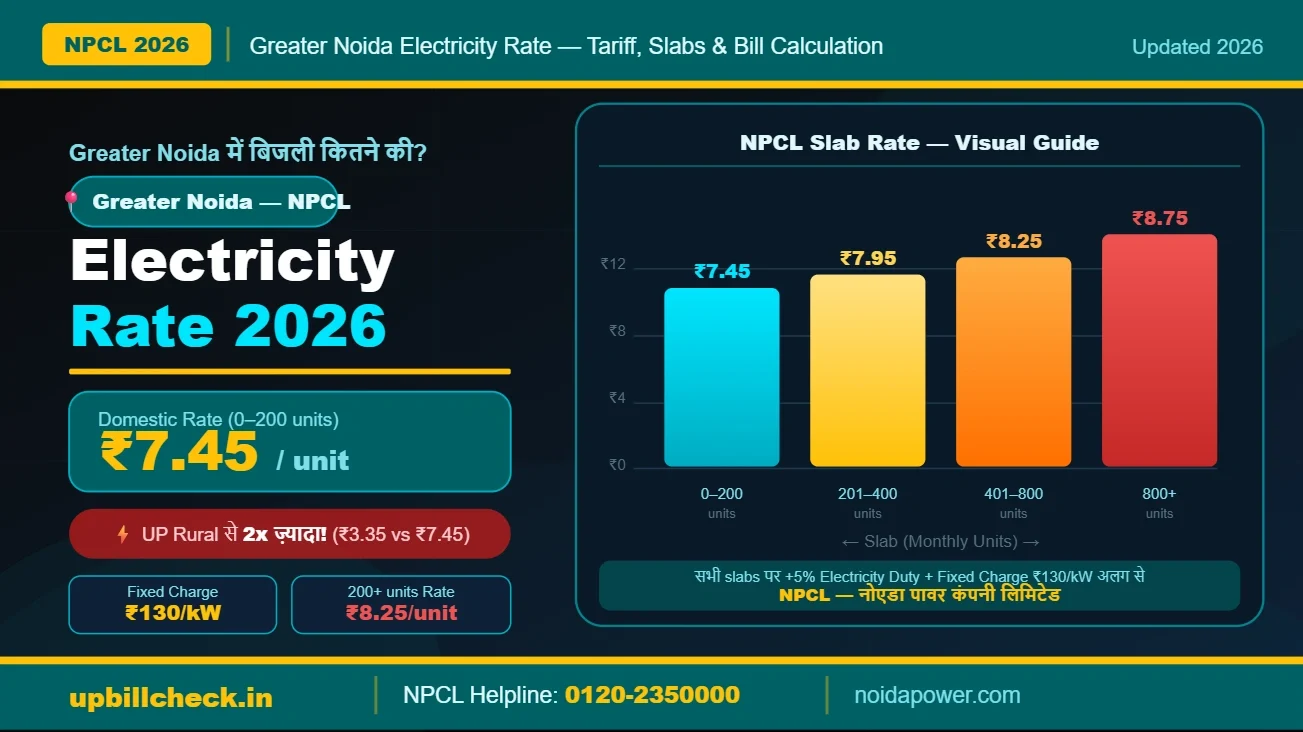
Greater Noida Electricity Rate 2026: If you live in Greater Noida, your electricity bill can look confusing because the supply system is not exactly the same as the rest of Uttar Pradesh. Most areas here are served by NPCL, and UPERC has kept NPCL’s retail tariff unchanged for FY 2025-26, with consumers continuing to get a 10% regulatory discount.
The bigger issue is that many people only look at the final bill amount and do not understand slab rates, fixed charges, or FPPAS. Once you know how these parts work, it becomes much easier to check whether your bill is correct and how to reduce it. This guide explains the latest Greater Noida electricity charges 2026 in a simple way
Quick Reference: Greater Noida Power Overview
| Detail | Information |
|---|---|
| Power Supplier | NPCL (Noida Power Company Limited) — for most of Greater Noida |
| Urban Domestic Rate | ₹5.50 to ₹6.50 per unit (slab-wise) |
| Lifeline Rate | ₹3.00 per unit (1kW load, up to 100 units) |
| Regulator | UPERC (Uttar Pradesh Electricity Regulatory Commission) |
| Helpline | NPCL: 0120-6226666 | UPPCL: 1912 (Toll-Free) |
Who supplies electricity in Greater Noida?
Greater Noida mostly gets electricity from NPCL, which is a private distribution company. Some nearby or peripheral areas may still fall under UPPCL/PVVNL, so the bill should be checked first before comparing rates.
If your bill shows NPCL or Noida Power, you should follow NPCL’s tariff structure. If it shows PVVNL or UPPCL, then the rates and complaint process can be different. That one check saves a lot of billing confusion later.
NPCL domestic tariff 2026
NPCL doesn’t really split rates by geography. Instead, it bills two different kinds of domestic setups differently — and knowing which one applies to you matters more than knowing your PIN code.
Category 1 — Rural Schedule (Townships, Societies, Apartment Complexes)
This category covers registered housing societies, townships, residential colonies, and multi-storey apartment complexes — including shared loads like lifts, water pumps, and common-area lighting. Despite the name, it’s not about rural geography.
| Consumption | Fixed Charge | Energy Charge |
|---|---|---|
| Lifeline (≤1kW, up to 100 kWh) | ₹50/kW/month | ₹3.00/unit |
| Up to 100 kWh | ₹90/kW/month | ₹3.35/unit |
| 101–150 kWh | ₹90/kW/month | ₹3.85/unit |
| 151–300 kWh | ₹90/kW/month | ₹5.00/unit |
| 301–400 kWh | ₹90/kW/month | ₹5.50/unit |
| 401–500 kWh | ₹90/kW/month | ₹5.75/unit |
| 501–600 kWh | ₹90/kW/month | ₹6.00/unit |
| 601–700 kWh | ₹90/kW/month | ₹6.25/unit |
| 701–800 kWh | ₹90/kW/month | ₹6.50/unit |
If your usage is 250 units, the first 150 units are charged at ₹5.50 and the remaining 100 units at ₹6.00. The whole bill does not get charged at one flat rate.
Category 2 — Other Domestic (Standalone Houses)
This applies to individual homes that don’t fall under a registered society or township setup.
| Consumption | Fixed Charge | Energy Charge |
|---|---|---|
| Lifeline (≤1kW, up to 100 kWh) | ₹50/kW/month | ₹3.00/unit |
| 0–150 kWh | ₹90/kW/month | ₹5.50/unit |
| 151–300 kWh | ₹90/kW/month | ₹6.00/unit |
| Above 300 kWh | ₹90/kW/month | ₹6.50/unit |
Bulk Supply Tariff for Large Connections
For single-point connections with a sanctioned load of 50kW or above — typically large townships or commercial complexes — NPCL applies a separate bulk supply rate.
| Category | Fixed Charge | Energy Charge |
|---|---|---|
| Bulk Supply (≥50kW) | ₹110/kW/month | ₹7.00/unit |
Lifeline consumers get lower rates
NPCL also has a lifeline category for low-usage households. This applies where sanctioned load is up to 1 kW and the monthly use is up to 100 units.
For this category, the energy charge is only ₹3.00 per unit for the first 100 units, and the fixed charge is much lower at ₹50 per month. That makes it useful for small homes with limited electricity usage.
Fixed Charge, Electricity Duty, and FPPAS
Your bill is not only based on units consumed. It usually includes fixed charge, electricity duty, and FPPAS, which is why the final amount often looks higher than expected.
Fixed charge depends on sanctioned load, not on how much electricity you used that month. Electricity duty is a government levy, while FPPAS is the fuel and power purchase adjustment surcharge, which can change with market conditions and seasonal power purchase cost.
How to Check and Pay Your NPCL Bill Online
NPCL lets you check your bill and consumption history through its website or mobile app, and pay via the website itself or third-party apps like PhonePe and Paytm.
To pay online:
- Go to NPCL’s official website.
- Click “Payment Options” on the homepage.
- Choose “Online Payment” and log in, or select “Quick Bill Pay.”
- Enter your consumer number and required details under Quick Bill Pay.
- Pick a payment method — debit card, credit card, net banking, or UPI — and complete the payment. You can download or print the receipt afterward.
Paying via NEFT/RTGS Bank Transfer
If you’d rather pay through a direct bank transfer, NPCL also accepts NEFT/RTGS payments.
| Detail | Information |
|---|---|
| Beneficiary Account No. | NPCLTDXXXXXX (replace XXXXXX with your Contract Account Number) |
| Beneficiary Name | NOIDA POWER COMPANY LIMITED |
| Bank | HDFC Bank Ltd., Sandoz Branch, Mumbai |
| IFSC Code | HDFC0000240 |
Commercial connections are costlier
Shops, offices, and business connections in Greater Noida usually pay more than domestic consumers. Commercial tariffs are higher because the load pattern and supply structure are different.
In older NPCL tariff reporting, commercial fixed charges were also higher than domestic rates, and the same logic still applies: the more load you sanction, the more fixed charge you pay every month.
So if you are taking a new commercial connection, do not overestimate load just to stay safe. An oversized sanctioned load can quietly increase your bill every month even when consumption is low.
How to calculate your bill
Bill calculation becomes easier when you break it into parts. First, note your current meter reading and subtract the previous reading to get the total units used. Then apply the slab rates to those units, add the fixed charge, and finally add duty and surcharges.
For example, if you used 250 units, the first 150 units are billed at the first slab and the next 100 units at the second slab. After that, fixed charge and duty get added, so the total is naturally higher than a simple multiplication.
Registering a Complaint with NPCL via SMS
NPCL also supports a simple SMS-based system for common service requests — useful if you don’t want to use the app or call customer care.
Send the relevant code along with your consumer number to 7840002288.
| Code | Purpose |
|---|---|
| #RT | Report power theft |
| #BD | Raise a billing dispute |
| #DA | Check pending dues |
| #DB | Get bill sent to your registered email |
| #MB | Report a burnt meter |
| #SR | Submit your own meter reading |
| #INFO | Get contract account, load, rate category, premise ID |
| #ST | Check status of an existing complaint |
| #NP | Report no power / outage |
| #WR | Report a wrong meter reading |
| #MD | Report a damaged meter |
| #LP | Check last payment details |
Checking Power Cut / Outage Status Online
NPCL has added an outage-tracking feature so you can check planned power cuts or maintenance shutdowns in your area before they happen.
- Visit the NPCL official website.
- Click “Outage Notification” on the homepage.
- View the list of planned power cuts and maintenance shutdowns for your area.
NPCL Helpline Numbers — Customer Care vs Emergency
NPCL maintains separate numbers depending on what you need.
- Customer care / Helpline: 0120-6226666
- WhatsApp support: 0120-6226666
- Emergency number: 9718722222
FAQs
What’s the electricity rate in Greater Noida in 2026?
For NPCL domestic urban connections, the rate ranges from ₹5.50 to ₹6.50 per unit depending on the slab.
Does NPCL or UPPCL supply electricity in Greater Noida?
Most of Greater Noida is served by NPCL, but some peripheral areas still fall under PVVNL/UPPCL. Check your bill to confirm your provider.
How do I get the lifeline category benefit?
If your sanctioned load is up to 1kW and usage stays under 100 units, you’re automatically eligible — if you’re not in that category yet, contact NPCL customer care.
Why does the fixed charge apply even if I don’t use electricity?
The fixed charge covers your sanctioned load, not actual consumption — it helps fund infrastructure maintenance.
Why does FPPAS show up as an extra charge on my bill?
When power purchase costs rise — like during high summer demand — the discom recovers that extra cost from consumers through FPPAS.
How much higher is the commercial rate compared to the domestic rate?
Commercial rates can go up to ₹6.70-7.95 per unit, noticeably higher than the ₹5.50-6.50 domestic range.
Conclusion
Electricity in Greater Noida works a bit differently since most of the supply comes from a private company, NPCL, rather than directly from UPPCL. Once you know your correct provider, your slab, and your sanctioned load, calculating your own bill becomes a lot easier.
If you ever run into a billing issue or need to file a complaint, UPPCL’s helpline 1912 is available 24×7 as well.

I am Vikas Kumar, a Chemistry graduate, and I’m a digital content creator and SEO specialist by profession, driven by a keen interest in simplifying complex information for everyday readers. For the past 3 years, I’ve been creating research-backed content on UPPCL electricity billing, tariffs, and government schemes to help UP consumers get clear, accurate information. You can instantly calculate your monthly electricity costs with our custom UP Electricity Bill Calculator.